Incoterms
Incoterms (International Commercial Terms) are the standard terms used in sales contracts for
importing and exporting. They are used to define responsibility and liability for goods over the
course of a shipment. In other words, they spell out when responsibility for the goods transfers
from the supplier to the buyer. They also define who pays which costs for the goods and their
transport.
Incoterm Categories
In total, there are 11 incoterms, divided into four main categories. You can recognize a category
by the first letter of an incoterm.
| “E” terms(EXW) |
The buyer arranges everything related to the transport.
The only term where the seller/ exporter makes the good available at his own
premises to the buyer/ importer.
|
| “F” terms(FCA, FAS AND FOB) |
The buyer arranges most things related to the transport.
The seller/exporter is responsible to deliver the goods to a carrier named by the
buyer.
|
| “C” terms(CFR, CIF, CPT AND CIP) |
The seller arranges most things related to the shipping.
The risk of the transport is assigned to the buyer.
Terms where the seller/exporter is responsible for contracting and paying for
carriage of the goods, but not responsible for additional costs or risk of loss or
damage to the goods once they have been shipped.
|
| “D” terms(DAP, DPU AND DDP) |
These assign the responsibilities to the seller. The seller carries the risks and
pays
the bills.
Terms where the seller/exporter is responsible for all costs and risks associated
with
bringing the goods to the named place of destination.
|
Role of Incoterms:
| Obligations |
The role of the seller and the buyer in organizing transportation, insurance of
goods, shipping documents, etc. |
| Risks |
Defines the transfer of risks, e.g. in case of breakage or damage |
| Costs |
Who is responsible for the costs between the seller and the buyer.eg. packaging,
loading/unloading of goods, security, etc. |
What Incoterms are not:
- Do not process:
- Transfer of ownership of the goods sold
- Intellectual property rights
- Export or import bans
- Possible remedies for breach of contract of sale
- Sales contract
- Imposition of customs duties.,etc.
- Is not a sales contract and does not replace it: they reflect commercial practices
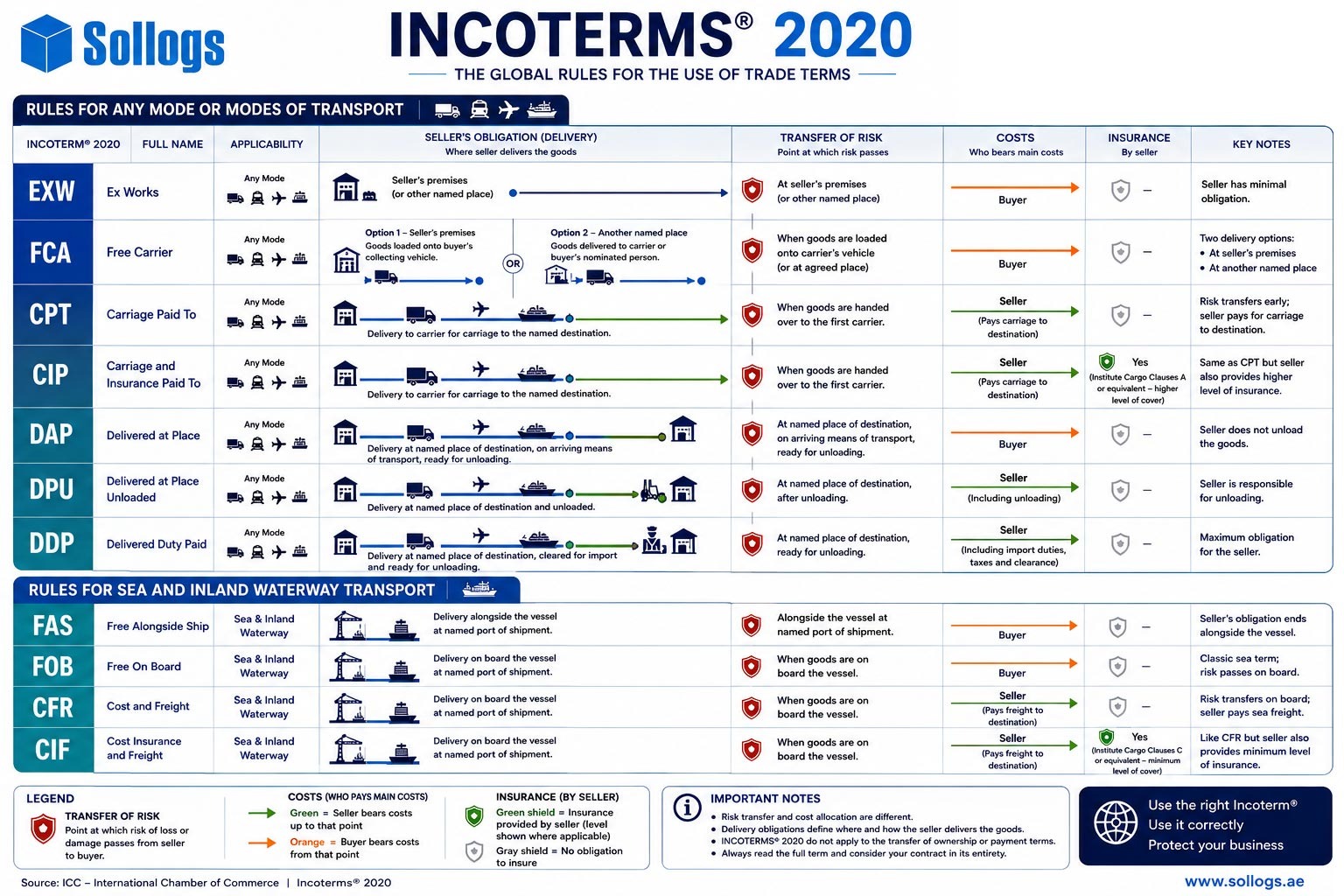
Incoterms Explanation :
There are 11 Incoterms for commercial exchanges, which consist of three letters:
Ex Works (EXW)
In case of Ex Works (EXW), all responsibilities are assigned to the buyer. The seller has the
responsibility to make the goods available at a designated place and time. This location must be
agreed upon in the terms of delivery. In most cases, this will be a warehouse or factory owned
by the seller. All risks and costs related to the transport are assigned to the buyer. This
includes the loading of the goods at the designated place. EXW is not recommended for
international transports.
Free Carrier (FCA)
FCA means freigt-free to carrier. In this case, the transporter ships the goods to an agreed upon
place of delivery. The risks of the shipping transfer to the buyer when the goods are delivered
to the first carrier.
Within FCA, a delivery can happen two ways. This does not have to be mentioned in the contract:
- If the agreed point of delivery is the factory or the office of the seller, the risk of
transportation transfers when the goods are loaded on the vehicle of the buyer.
- When the point of delivery is elsewhere, the risks transfers once the goods are made
available to the buyer and ready for unloading.
After the delivery, the buyer carries the risks and costs of the transport. An important
difference with FCA is that the seller is responsible for customs related to the export of the
goods. All customs related to transit and import are arranged by the buyer.
Carriage Paid To (CPT)
With CPT, the seller takes care of the transport and costs until a agreed upon point of delivery.
The risks of the transport are transferred to the buyer in an earlier stadium, being when the
goods are delivered to the first carrier. The transfer of costs and risks do not happen at the
same time. All costs and responsibilities related to the customs related to the export and
transit of the goods are assigned to the seller. The buyer arranges all customs related to the
import of the goods. If the terminal charges Terminal Handling Charges (THC), the buyer should
ask the seller if these costs are calculated within the transport price.
Carriage and Insurance Paid To (CIP)
In case of CIP, the seller takes care of the transport and transport costs until a agreed upon
point of delivery. The risks of the transport are transferred to the buyer in an earlier
stadium, being when the goods are delivered to the first carrier. The transfer of costs and
risks do not happen at the same time. All costs and responsibilities related to the customs
related to the export and transit of the goods are assigned to the seller. The buyer arranges
all customs related to the import of the goods. If the terminal charges Terminal Handling
Charges (THC), the buyer should ask the seller if these costs are calculated within the
transport price.
The difference with CPT, which is described above, is that the seller is obliged to take out a
goods transport insurance for the buyer’s goods. If this insurance is not enough to cover the
costs of the damages, the buyer will have to cover the extra costs.
Delivered at Place Unloaded (DPU)
DPU assigns the responsibility for risks and costs to the seller until the agreed upon point of
delivery. The seller will have to unload the goods for the buyer. All costs and responsibilities
related to the customs related to the export and transit of the goods are assigned to the
seller. The buyer arranges all customs related to the import of the goods.
Delivered At Place (DAP)
DPU assigns the responsibility for risks and costs to the seller until the agreed upon point of
delivery. The seller will have to offer the goods to the buyer, but he is not obliged to unload
them. This is the difference with DPU, as described above. All costs and responsibilities
related to the customs related to the export and transit of the goods are assigned to the
seller. The buyer arranges all customs related to the import of the goods.
Delivered Duty Paid (DDP)
DDP assigns the responsibility for risks and costs to the seller until the agreed upon point of
delivery. The seller will have to offer the goods to the buyer, but he is not obliged to unload
them. This is the same as DAP. The difference is in arranging the customs. All costs and
responsibilities related to the customs related to the export, transit, ánd import of the goods
are assigned to the seller.
Difference DAP and DDP
In essence, DAP and DDP are the same. The seller is responsible for risks and transport costs
until the agreed upon point of delivery. The only difference is that costs and responsibilities
related to the customs related to the export, transit, ánd import of the goods are assigned to
the seller in case of DDP. In case of DAP, the buyer arranges all customs related to the import
of the goods.
Free Alongside Ship (FAS)
FAS is only used in case of shipping. With FAS, the goods must be delivered alongside the ship.
In practice, this means besides the ship. Before the delivery besides the ship, all costs and
risks are assigned to the seller. After delivery, the buyer carries them. All costs and
responsibilities related to the customs related to the export and transit of the goods are
assigned to the seller. The buyer arranges all customs related to the import of the goods.
This Incoterm is relevant for bulk and piece goods. Containers are often transferred in the
terminal. In that case, FCA is more relevant.
Free On Board (FOB)
FOB is also only used in case of shipping.In case of FOB, the goods must be delivered on the ship
chosen by the buyer.
Before the delivery on the ship, all costs and risks are assigned to the seller and on the ship
they are split between buyer and seller. After unloading from the ship, the buyer carries them.
All costs and responsibilities related to the customs related to the export and transit of the
goods are assigned to the seller. The buyer arranges all customs related to the import of the
goods.
Cost and Freight (CFR)
The seller carries all costs of the transport, until the goods arrive at the port of arrival. The
risk of the transport is transferred to the buyer earlier, being when the goods are loaded onto
the ship. An important detail is that insurance of the goods is not part of the agreement.
If the terminal charges Terminal Handling Charges (THC), the buyer should ask the seller if these
costs are calculated within the transport price. All costs and responsibilities related to the
customs related to the export and transit of the goods are assigned to the seller. The buyer
arranges all customs related to the import of the goods.
Cost Insurance and Freight (CIF)
The seller carries all costs of the transport, until the goods arrive at the port of arrival. The
risk of the transport is transferred to the buyer earlier, being when the goods are loaded onto
the ship. This is the same as CFR. The difference with CFR, which is described above, is that
the seller is obliged to take out a goods transport insurance for the buyer’s goods in case of
CIF. This is not necessary with CFR.
If the terminal charges Terminal Handling Charges (THC), the buyer should ask the seller if these
costs are calculated within the transport price. All costs and responsibilities related to the
customs related to the export and transit of the goods are assigned to the seller. The buyer
arranges all customs related to the import of the goods.
Transport Modes to use Incoterms:
- Transport of goods by boat (Sea or River) :
- FAS (Free Alongside Ship)
- FOB (Free On Board)
- CFR (Cost and Freight)
- CIF (Cost, Insurance and Freight)
-
Multimodal freight transport (All Modes Covered) :
- EXW (Ex Works)
- FCA (Free Carrier)
- CPT (Carriage Paid To)
- CIP (Cost, Insurance and Freight)
- DPU (Delivered at Place Unloaded)
- DAP or DDU (Delivered At Place)
- DDP (Delivered Duty Paid)

 Enter your number in the Format: <Area Code> <Phone Number>